
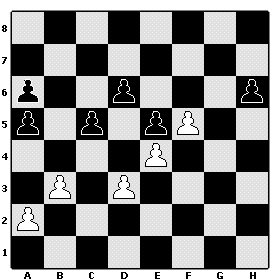
Pawn structure is the formation that your Pawns are in. Because Pawns have limited mobility, their structure is very important. The diagram on the left shows a number of different Pawn setups. Here are some of the different types of Pawn formations:
| A passed Pawn is one that has no opposing Pawns on it's file or a file next to it. In the above position, Black has a passed Pawn on h6. A protected passed Pawn is the same thing, except the Pawn is protected by another Pawn. White has a protected passed Pawn on f5. Passed Pawns are very valuable because they are much easier to promote.
| An isolated Pawn is one where there are no other friendly Pawns on adjacent files. This makes an isolated Pawn hard to defend, so they are usally a weakness. Black has an isolated Pawn on h6.
| Backward Pawns have other Pawns on either side of them, but their friends are too far advanced to be able to protect them. If a backward Pawn can be moved forward safely, where it's alongside another friendly Pawn, it loses it's 'backward' status and becomes more valuable. White and Black both have a backward Pawn on the d-file in the above position.
| Doubled Pawns are two Pawns, controlled by the same player, that are both on the same file. They cannot protect each other, making them a weakness. Black has doubled Pawns on the a-file.
| A Pawn chain is a group of Pawns that protect each other. Pawn chains can be a variety of lengths. In the diagram above, White's Pawns on d3, e4, and f5 create a Pawn chain.
| |