This is a game that was played in 1858 by Paul Morphy, universally recognized as the best player in the world during his time. He played this magnificent game against the combined talents of the Duke of Braunschweig and Count Isouard. We have included it here and annotated it for you to see. If you have trouble following our annotation, set up a board and follow each move as it is made. Enjoy!
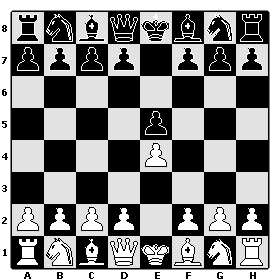
1.e4
When the game starts, all of the pieces are locked behind pawns, so this first move is commonly played. It releases the Queen and Bishop to their diagonals, and controls the center with a Pawn.
1...e5 (see diagram)
Black plays the same move for the same reason. Games that begin like this are commonly reffered to as 'double king pawn' games, because both players have pushed their king pawns two squares on the first move.
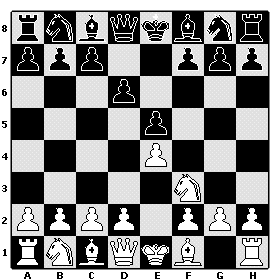
2.Nf3
This is a good move, because White is getting his pieces out into play quickly, which is called developing. Knights are much more powerful in the center of the board than on the side or corner. A Knight in the center controls no less than eight squares, whereas a Knight in a corner controls only two!
2...d6 (see diagram)
Although Black's move defends his attacked Pawn, it's not the best move, because Black's black-squared Bishop is now blocked by the d6-Pawn. 2...Nc6 is better, because it develops a Knight.
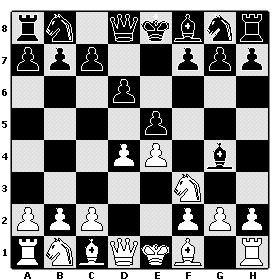
3.d4
White knows how to get the game going! With this move, he is opening lines for an attack. Because he is ahead in development, he can make more use of the opened files and diagonals.
3...Bg4 (see diagram)
This looks like a good move, because it pins the Knight to the Queen, but it actually allows White to make an advantagous trade with his next move.
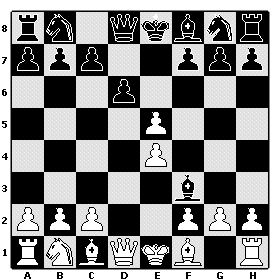
4.dxe5
Now, if Black recaptures with 4...d6xe5, then White can win a Pawn. Do you see how? After 5. Qxd8+ Kxd8, (getting out of the pin,) then 6.Nxe5.
4...Bxf3 (see diagram)
This move is forced, if Black wants to retain the Pawn. By eliminating White's Knight, the attacker of his Pawn is removed.
5.Qxf3
It is better for White to recapture with his Queen, because it is more active on f3 than on it's original square.
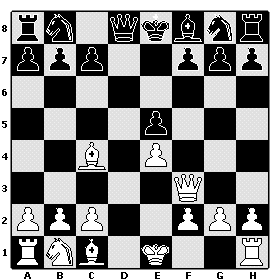
5...d6xe5
Now, it's safe to recapture the Pawn.
6.Bc4 (see diagram)
Do you see White's threat? The f7 Pawn is attacked twice (by the Bishop and Queen), and defended only once, by Black's King. If White can take it with his Queen, checkmate would result. Black must respond to this threat if he wants to stay in the game.
6...Nf6
This move is definitely the best way to defend. Black blocks the Queen's path to f7, and develops another piece.
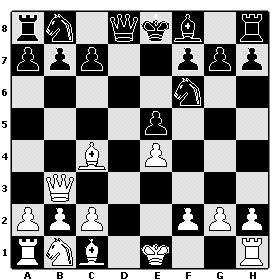
7.Qb3 (see diagram)
This move creates a fork! White's Queen now strikes at f7 as well as b7, winning a Pawn either way. Black can't defend both in one move.
7...Qe7
This protects the threatened f7-Pawn, but it leaves the other hanging.
8. Nc3
This is a very strong move. Even though after 8.Qxb7 Qb4+ 9.Qxb4 Bxb4+ 10.c3 White would end up a Pawn ahead with a technical win, 8.Nc3 is actually better, because it improves White's growing advantage: his lead in devolopment.
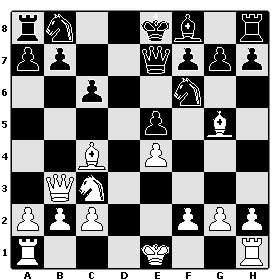
8...c6
This move defends Black's b7-Pawn and keeps the opposing Knight out of d5, where it would become a dominating piece.
9.Bg5 (see diagram)
White brings out yet another piece. His control of the board is becoming more obvious, while Black is pretty cramped.
The rest of the game is a wild battle, involving a complicated attack.
Press 'next' to go to Part Two and see it.