Rock art
Brief History
Since the San and Khoikhoi (Bushmen) did not have their own written language, they used their art to record the past on rock faces and sandstone where they roamed. It is important to understand that these paintings were not done to decorate their dwellings, but had deeper meanings and symbolism of their rituals and life, which they wanted to share with others.
It is suggested that the bulk of San rock painting was created within the last 2000 years. There are more than 15000 reported sites of rock art paintings and engravings, scattered around Southern Africa, of which the best are considered to be those in the eastern regions, the KwaZulu Natal Drakensberg, where in one area alone, 4000 pictures can be seen.
The San used mineral salts, obtained from their immediate environment, such as manganese, zinc and iron, to manufacture their paints. Manganese was used for black, iron for the warm colours red, yellow and brown, while zinc provided white. These ingredients (pigments) they mixed with blood or urine, egg yolk or sap from certain plants.
Scientists class the paintings in three groups generally, namely monochrome, (one colour) bichrome (two colours) and polychrome (multi-coloured).
What did they paint?
Analysts have discovered that the earlier paintings depicted beautiful and peaceful scenes of animals (mainly eland) and people, whereas the later ones, after the 17th century, showed war-like situations of cattle-raiding and fighting between humans. This was ascribed to other groups arriving from the north and settlers from the south, which threatened their existence.
Rock art sites are protected by law to preserve it for our cultural heritage.
The Linton Stone is one excellent example of rock art that can be seen in the South African Museum in Cape Town by those who cannot visit the sites.
|
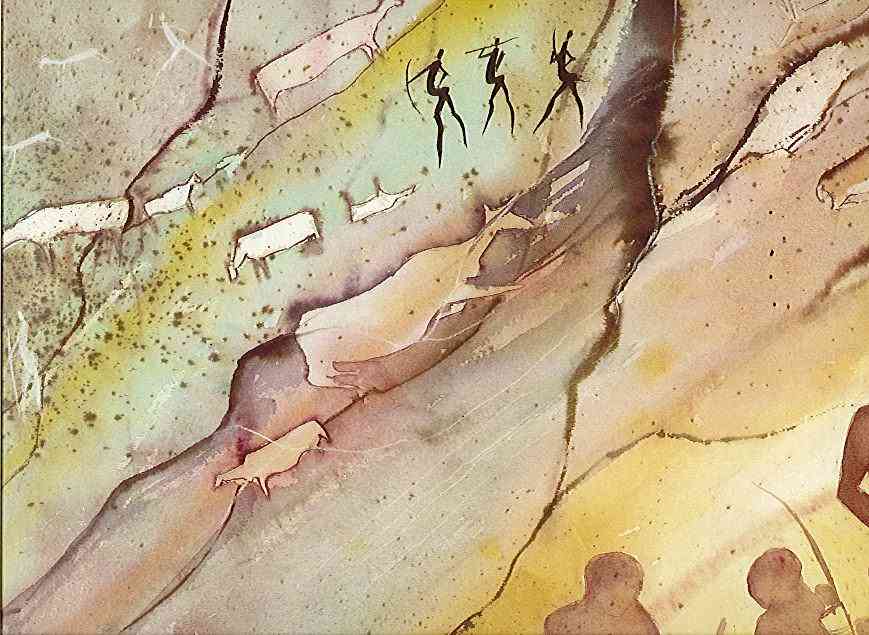
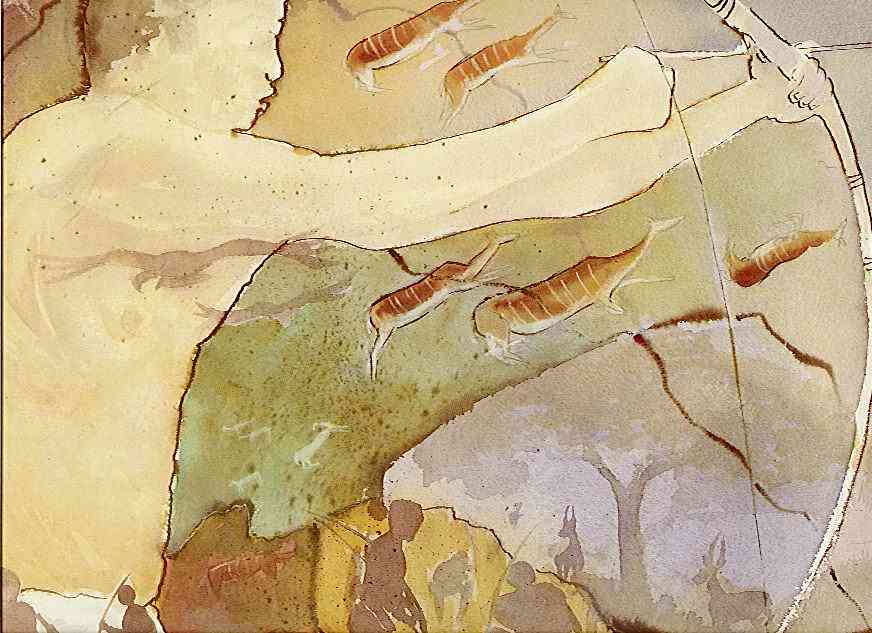
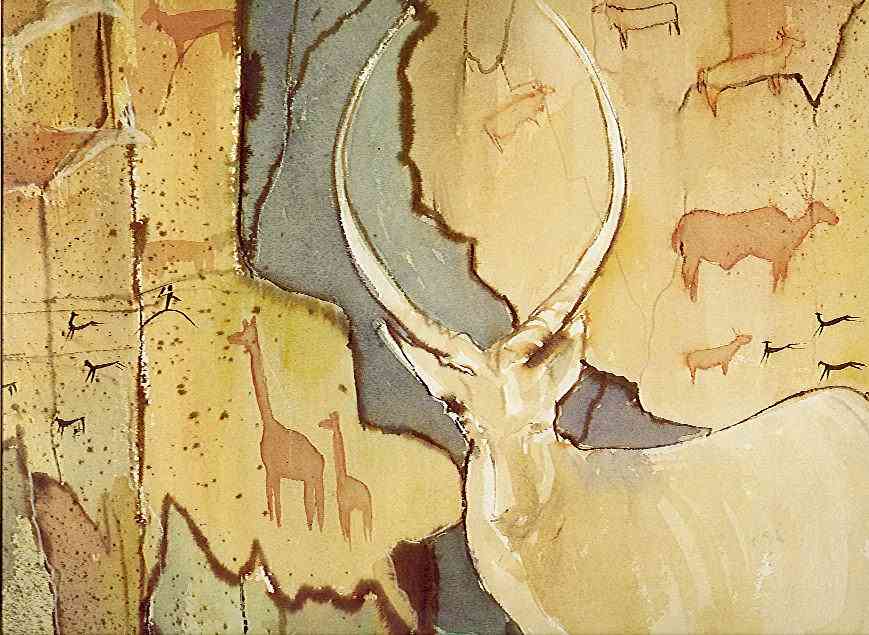
Paintings by local artist Lorna Panzenbock, featuring her interpretation of San rock art |
||
 |
 |
 |
Further reading on this fascinating subject can be done at http://www.museums.org.za/sam/resource/arch/painting.htm and http://www.wits.ac.za/science/archaeology/raru/publications.htm