
"Dual symbols of defence and authority, they in turn represent the powerful legs of the secretary bird. The spear and knobkierie are lying down, symbolism of peace."
www.gov.za/symbols/coatofarms.htm
The Spear and Knobkierie
The spear, knobkerrie and shield are strongly associated with the military might of the Zulu nation.
In the early 19th century, Shaka became king of the Zulus and it was he who changed the Zulus into the most feared tribe in Southern Africa.
Zulu
Weapons.
Shaka
invented a new spear. This spear had a long, double-edged blade with a short
handle, unlike the old spear, which had a small blade with a long handle. IKlwa
was the name given to this new spear, due to the sound it made when, after
impaling the victim, it was ripped out. This spear could only be called that
once it had been blooded in battle. This was a big change for the Zulu warriors,
who fought in units called impis,
because they had always fought from a distance, throwing their spears. Now they
had to get very close to the enemy and stab them.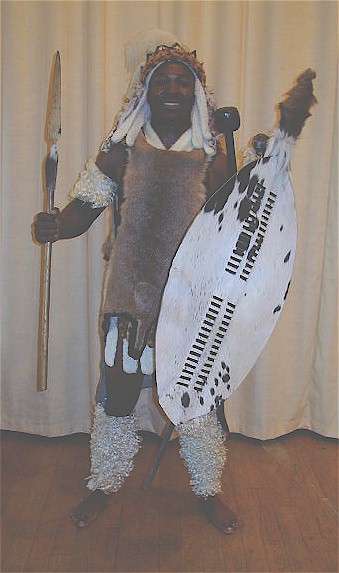
There
were a variety of other spears. The uNtlekwane was also a stabbing spear but it
was slightly lighter than the iklwa. The isiJula, isiPapa and iNgcula
were all throwing spears mainly used in hunting. The special iNtlenda spear
was reserved for royalty and chiefs. It was more elaborate with two wing-like
extensions at the end of the shaft.
When
a warrior went into battle, he carried his uKlwa in his right hand, and
his shield and other spears in his left hand. A knobkerrie often completed his
ammunition.
The
knobkerrie was called the iWisa. It was about 2 feet or 60cm in
length with a heavy round end. Some knobs were studded with brass to give extra
weight when being used to club an enemy. The isiMonqu knobkerrie was even
heavier and it was used to throw at an opposing warrior.