Module 9 - Using the Showing Evidence Tool to Target Thinking Skills
Activity 9.2
Digging Deeper into Argumentation
Step 1: Thinking About Your Classroom
Think of the variety of ways that argumentation is required in your classroom.
- When do your learners engage in argumentation?
- At what points do they have problems in creating and supporting a clear argument?
Step 2: Setting Up Expectations for an Argument
Research
suggests many benefits for including argumentation in the classroom but
also shows that learners have difficulty constructing arguments. When
learners in grades 5–12 have been asked to construct arguments
without specific instruction in this area, they typically generate weak
arguments (Means & Voss, 1996). Even with instruction, learners
have difficulty providing certain components of arguments, such as
describing their reasoning for why their evidence supports their claim
(McNeill et al., 2004). Learners need instructional support as they
construct arguments. Consider how you can use the Showing Evidence Tool
as a scaffold for learners, as well as the strategies you would need to
use in class to help learners create high-quality arguments.
Understanding the Parts of an Argument
It is important to discuss the components of an argument at its most basic levels before using the Showing Evidence Tool. This is particularly important with younger learners. The simplest argument consists of only a claim and evidence.
Claim — The conclusion or assertion that a person is attempting to prove.
Evidence — The facts or data used to either support or oppose the claim. This is also known as proof, data, arguments, observations, or grounds. The support of a claim can come in the form of facts and statistics, expert opinions, examples, explanations, logical reasoning, witness testimony, documentation, and so forth.
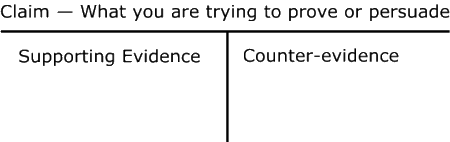
When an argument is more complicated, particularly when multiple claims could be supported, the following components become essential to evaluating and justifying the claim:
- Quality of the evidence
- Is the source reliable and credible?
- Is the author of the source just someone with a Web site or is the author an expert in the field? Is the associated organization well respected and considered trustworthy?
- Does the source have a built-in bias? If so, does it compromise the quality of the evidence?
- Is it a primary or secondary source?
- Other source quality evaluation criteria?
- How accurate is the evidence?
- How old is the evidence? Does age of the content matter for this topic?
- Is the evidence verifiable?
- Is the data presented appropriately/accurately? Is it misrepresented or taken out of context?
- Is the data or content provided as evidence of a fact, an interpretation of a fact, or someone's opinion?
- If the evidence is learner-created (experiments, mathematical proofs, their own data gathering, and so on), what steps were taken to ensure that the evidence is accurate?
- Other accuracy evaluation criteria?
| Note: View examples of argumentation errors and misuse of evidence. |
Strength of the evidence to support or oppose the claim
Were all important counter-arguments explored and included?
Is the evidence central to the argument?
- Does the evidence go to the heart of the claim?
- If this piece of evidence were taken away, would your argument fall apart?
- Does the evidence provide only superficial or minor support?
- Other strength criteria?
- Reasoning for why the evidence supports or opposes the claim
- What general principle or idea allows that connection?
- How does this particular piece of evidence support or oppose the claim?
- What general principle or idea allows that connection?
- Other reasoning criteria?

