Module 9 - Using the Showing Evidence Tool to Target Thinking Skills
Activity 9.2
Step 6: Evaluating the Claim
As evidence becomes attached to a claim, the pro and con arguments begin to stack up and provide a visual indication as to whether the scales are tipping one way or another for a supported claim or an unsupported claim. Both the and Support and the Quality ratings must be taken into consideration when weighing the evidence. Consider some of the discussions you might want to have with your class:
If a really poor-quality piece of evidence strongly supports a claim, should the evidence be disregarded?
-
What about a lot of mediocre support? How do we weigh quantity in comparison to quality?
What happens when a jury has to make a decision about whether someone is guilty or innocent? What are some of the things they consider? How can we relate that process to the evaluation of a claim?
What other discussions would you want to have with your class?
The Evaluation of a Claim rubric is a starting point for discussion in determining the overall rating of a claim. What would you change or add to this rubric to help your learners evaluate and rate the claim after evidence has been collected and considered?
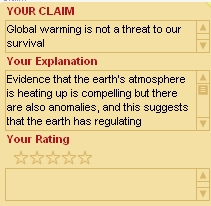
In your own classroom, you can determine how you want to use the description areas of the claim. In this case, the section Your Explanation is used to provide additional detail to further define what the team means in their one-sentence claim. The Your Rating section is where learners make a final assessment with a five-star rating system as to whether the claim has been proven to be true or valid—or not—and to explain how they came up that determination.